In 2014, Whole Foods launched its first national ad campaign, "Values Matter," with an estimated budget of $15-20 million. The company's announcement declared: "We want people, and animals, and the places our food comes from to be treated fairly." Ads told shoppers "Know What Kind Of Life Your Dinner Lived" and "The Highest Standards Weren't Available, So We Created Them."
And Whole Foods did create them. The company built and funded its own in-house animal welfare rating program, the Global Animal Partnership (GAP), which gives animals in their meat case a rating based on various welfare standards. GAP was eventually spun off as a nonprofit, though GAP and Whole Foods continued to share management personnel. Whole Foods' website states that “in 2011 we began requiring third-party certification for the most-purchased species in the butcher case,” and in 2024 the company promised shoppers that every animal in the meat case would require third-party animal welfare certification.
The message is unambiguous: shop here, and you're not buying into cruelty.
But a decade of investigations and litigation by Farm Forward, Direct Action Everywhere, the Animal Legal Defense Fund, and other groups tells a different story. Again and again, investigations into the supposedly “humane” California farms filling Whole Foods' shelves have revealed ordinary factory farms and conditions counter to the certifications printed on the package. Here are seven Whole Foods suppliers, and seven ways the labels failed.
Alexandre Family Farm
Whole Foods has sold dairy products from Alexandre Family Farm for over a decade. The Del Norte County dairy company calls itself “America's First Certified Regenerative Dairy.” It has collected nearly every premium label: USDA Organic, Certified Humane, Regenerative Organic Certified. It was named a Whole Foods supplier of the year in 2021 and was featured on the company's “Restarting Dairy” webpage. But Whole Foods removed that page after Farm Forward published an investigation into Alexandre in April 2024, documenting systemic deception and animal abuse. Farm Forward's consumer-fraud investigation was built with farm worker whistleblowers, and gained major attention including coverage in The Atlantic. It exposed that Alexandre Family Farm was:
- Dragging disabled cows across concrete and gravel
- Mutilating cows, including dehorning adult cows and cutting cows' teats, with no pain management
- Shipping sick, injured, and lame cows to auction
- Putting salt in cows' eyes when they were suffering from an eye injury and then gluing a denim patch over the eye, often gluing a cow's eye shut in the process, according to a whistleblower
- Violating organic rules, including spraying cows with diesel fuel and treating a cow's foot rot with tetracycline powder, an antibiotic, before selling the cow as organic
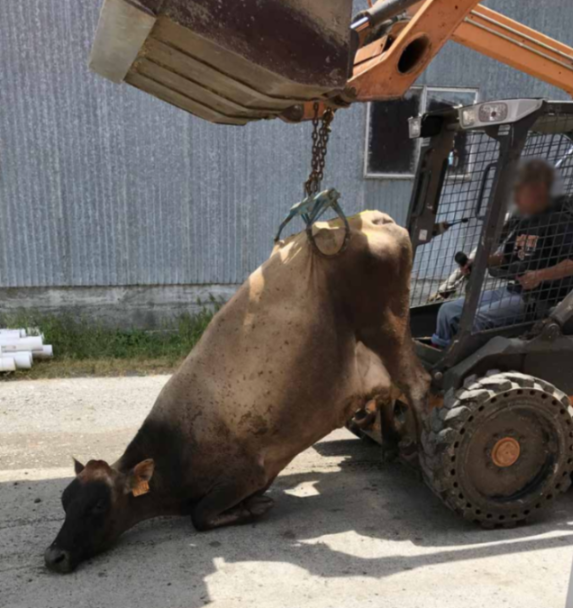
Image credit: Farm Forward, Dairy Deception
In September 2024, Legal Impact for Chickens filed an animal cruelty lawsuit against Alexandre based on Farm Forward's documentation. It specifically alleges the company poured salt into cows' eyes, dragged disabled animals across concrete, and starved and dehydrated cattle. The suit has survived Alexandre's attempted demurrer and an appellate challenge and is moving forward in Humboldt County Superior Court.
Alexandre is also facing a federal class action lawsuit for falsely representing its products as “humane” while engaging in animal cruelty. The lawsuit also targets Humane Farm Animal Care, the certifier behind the “Certified Humane” label.
Alexandre ultimately surrendered its Regenerative Organic certification in late 2025 and split with Certified Humane.
Despite all this, Whole Foods continues to sell Alexandre dairy, and Alexandre continues to rely on humanewashing and greenwashing its products. As Farm Forward put it, “the charm of the ‘Alexandre Family Farm’ name conceals its true structure: an industrial dairy spread over multiple locations (including a bucolic ‘show farm’) with the attendant harms of industrial production.”
It's also important to note that Farm Forward's investigation exposes how organic rules can actually deepen suffering: because milk labeled organic cannot come from antibiotic-treated cows, the program incentivizes farmers to withhold treatment from sick animals rather than lose the premium.
Clover Sonoma
Let's look at another of Whole Foods' “humane”-marketed dairy suppliers that has been caught in a scandal of animal abuse. Clover Sonoma was the first U.S. dairy to earn the “American Humane” certification, and the company's advertising, including its cartoon mascot, “Clo,” showcases happy animals in idyllic green hills. But Clover sources milk from multiple, large, feedlot-style dairy operations in the Central Valley, including Double D Dairies. In early 2026, Direct Action Everywhere (DxE) investigators used a drone to film workers at Agresti Calf Ranch in Ceres, which raises calves for Double D Dairies, kicking a calf in the face repeatedly, yanking calves by their tails, and pulling a calf's nose with pliers.
Drone footage also showed a calf disbudded with a hot iron with no anesthetic observed. Industry expert Temple Grandin reviewed the footage and said the calves' reaction indicates pain medication was not applied before the procedure.
After learning of the cruelty at Agresti Calf Ranch, Clover told The Los Angeles Times, “The rough handling shown at Agresti Calf Ranch is contrary and inconsistent with the humane practices we have fostered for decades and which we demand of all our suppliers.” Clover said that it had suspended Double D Dairies, but only temporarily. Clover quickly reinstated Double D and continues to prominently feature owner Dominic Agresti-Assali on its website.
Rather than thank the investigators who brought this cruelty to light, Clover Sonoma and Agresti Calf Ranch both turned to law firms to send DxE cease and desists threatening litigation. Agresti demanded that DxE stop “spying” on the farm's practices, and Clover demanded that DxE stop publishing “damaging statements” about the company.
The reality is that every Clover-supplying dairy farm separates newborn babies from their mothers and isolates them in tiny crates, either on-site at the dairy farm or off-site at a calf-raising operation like Agresti.
Sunrise Farms
Whole Foods also carries Clover Sonoma eggs, which are supplied by multiple companies including Sunrise Farms. Like Clover's milk, its eggs are all supposedly “American Humane” certified. Sunrise Farms is also “Certified Humane.”
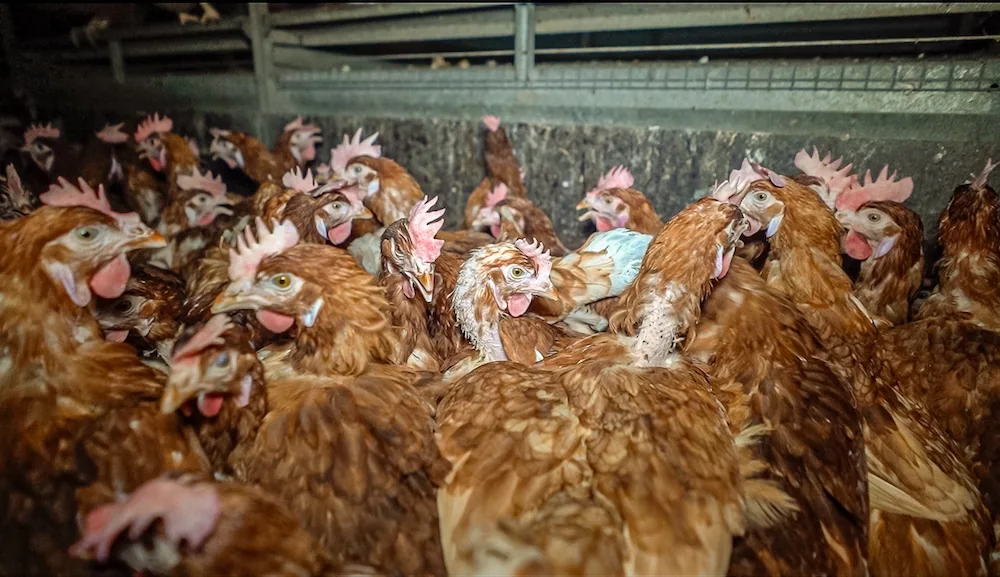
Sunrise operates at least nine egg factory farms in California, the largest confining over 500,000 hens, who never step foot outdoors. DxE investigated Sunrise's Sonoma County facilities repeatedly between 2016 and 2023. Investigators documented tens of thousands of hens in 15-foot rows of stacked cages more than a year after Proposition 2 banned that intensive confinement. DxE's investigations also documented sick and dead birds, hens suffering prolapses (where their reproductive organs protrude from their bodies), hens with eye injuries likely caused by stress-induced pecking in the crowded conditions, and a hen who was stuck in the wire of her cage.
Sunrise Farms co-owner Mike Weber testified in court that his facilities never kill hens by cervical dislocation (neck-breaking), but 2021 undercover footage obtained by DxE showed employees doing exactly that — wringing birds' necks and throwing them to the ground while their wings are still flapping. And in 2023, Sunrise killed 115,000 hens via a brutal mass kill method called “ventilation shutdown plus heat,” or VSD+. The ventilation shutdown part involves sealing all the vents in the barns, and the plus involves pumping in heat and steam. With this mass kill method, birds die of heatstroke. VSD is widely condemned by veterinarians as inhumane. None of this cost Sunrise its “Certified Humane” seal.
Petaluma Egg Farm
Look around the rest of the egg aisle at Whole Foods and you'll see cartons of Uncle Eddie's Wild Hens, Judy's Family Farm, and Rock Island, all of which come from the same company: Petaluma Egg Farm — as do some of Whole Foods' own 365 brand eggs. Each brand gets its own folksy packaging, obscuring that they all flow from one producer operating multiple factory farms.
Like some of the other factory farm companies on this list, Petaluma Egg Farm uses a singular name (farm, not farms) while operating multiple factory farms across Northern California. The deception goes further than just implying they have one farm. The company directly states on its website: “Every egg we produce comes from our North Bay farm.” In reality, the eggs come from several factory farms, where hens live crowded with thousands of others, with little to no outdoor access. In 2014, the Animal Legal Defense Fund settled a false-advertising lawsuit that forced Petaluma Farms to strip misleading outdoor-access imagery from Judy's cartons. DxE documented hens living in dirty, ammonia-filled sheds and partial debeaking, where hens have part of their beaks cut off to prevent cannibalism caused by the stress of so many thousands of animals living in close quarters.
DxE published Truth Matters, a 19-minute video about its investigation into Petaluma Egg Farm to show the reality that egg-laying hens face behind Whole Foods' “Values Matter” marketing.
Mary's Chicken
Mary's, California's second-largest poultry producer, owned by Pitman Family Farms, carries the “Certified Humane” label and Whole Foods' GAP ratings of 3 or higher. Pitman Family Farms owns at least 64 factory farms of chickens, ducks, and turkeys in California. The largest confines 695,000 chickens at a time. A 2017 DxE investigation into Mary's found supposedly “free-range” chickens confined indoors in crowded, filthy sheds, birds with pecked-out eyes and other injuries, and evidence of debeaking, despite advertising claiming Mary's performs no such mutilations. Investigators searched on all the farms they visited for signs that the birds went outside, but found none. They found no feathers or fecal matter outside, or other indications that the birds might be going outside.
DxE's investigation highlighted that the idyllic birds in the company's website photos and videos came from a single showcase farm in the San Joaquin Valley. These “pasture-raised” birds account for only a tiny fraction of Pitman's output of millions of chickens slaughtered each year. The vast majority of the company's farms are rated Step 3, which still promises “enhanced outdoor access,” a promise DxE found no evidence to back up.
Diestel Turkey
Diestel Turkey Ranch held a Step 5+ GAP rating, the top of Whole Foods' welfare scale, achieved by only a handful of suppliers out of thousands. But DxE's nine-month investigation, which broke in the Wall Street Journal and Washington Post, found the picturesque Sonora ranch featured in Diestel's and Whole Foods' marketing produced only a tiny fraction of its turkeys. Most birds were raised at an industrial facility in Jamestown, where investigators found overcrowding, birds trapped in feces, swollen eyes, open sores, and dead turkeys on barn floors.
Diestel also sells birds from Norbest in Utah, where DxE investigators documented birds packed into filthy industrial sheds, many diseased or pecked nearly to death. Norbest is owned by Pitman Family Farms, the same company behind Mary's. Not only are these humane-marketed companies much larger than they at first appear, but they are also tied to other massive industry players.
Meyenberg Goat Milk
Meyenberg is the largest goat milk producer in the country. Its purple cartons are stocked at Whole Foods nationwide. In early 2025, DxE investigators documented by drone a mass dead pile of mother and baby goats at a Meyenberg-supplying farm called Vera Goat Dairy in Stratford, CA. State water records show the property was cited back in 2021 for improperly disposing of dead goats on the property, and DxE's investigation showed the violations did not stop.
Investigators collected two deceased baby goats from the dead pile and brought them to the California Animal Health and Food Safety laboratory at UC Davis for necropsy testing. Their tests found both goats had coccidia parasites and “marked emaciation” “with no fat reserves” and “muscle atrophy.” These results suggest that these baby goats may have starved to death. One of the babies was also found to have a severe respiratory infection, “bacterial bronchopneumonia, most likely caused by Escherichia coli bacteria.” She had a large quantity of thick foam found in her trachea suggesting that asphyxiation may have been her immediate cause of death.
DxE also found live animals with respiratory infections and mothers with painfully engorged, distended teats.
Meyenberg claims to only source milk from dairy farms that are “Certified Humane,” but Vera Dairy is violating several of the requirements that goat dairy operations must meet under the “Certified Humane” standard. For example, an animal who is “suffering from a contagious illness or susceptible to further injury must be: 1. Segregated; 2. Treated without delay.” DxE found sick, emaciated goats in a barn among hundreds of other goats; two goats rescued from the barn and taken to veterinary care were both found to have pneumonia.
“Certified Humane” is a label that farms pay to use in their marketing, and which enables them to charge more for their products. In addition to application, renewal, and farm inspection fees, a dairy farm pays a given fraction of a dollar per gallon of milk that they label “Certified Humane.” This profit-increasing marketing tool is no guarantee that animals are well cared for.
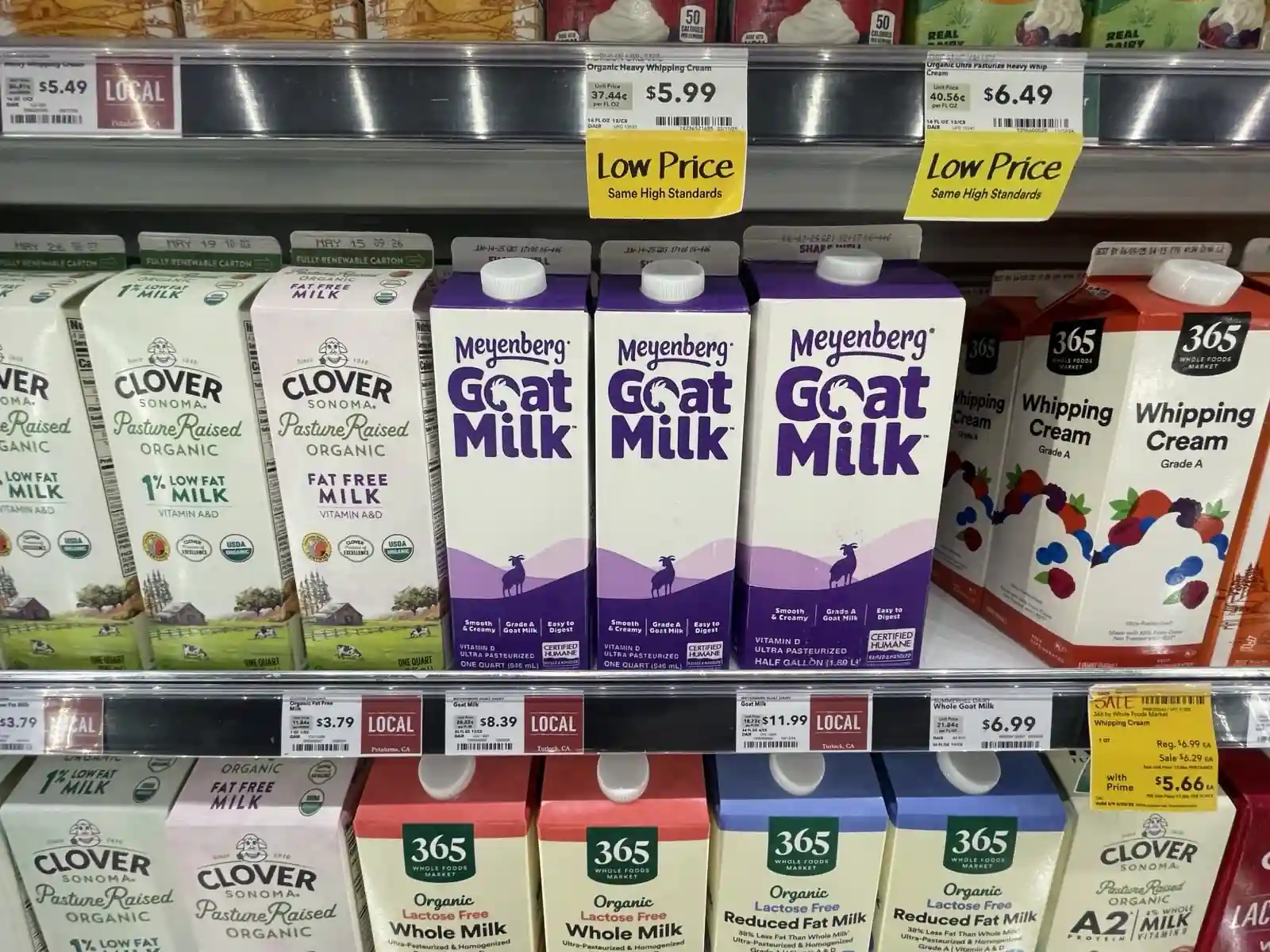
The high-end, Los Angeles grocery chain Erewhon decided to stop selling Meyenberg products after reviewing the animal cruelty documented by DxE at Vera Goat Dairy. In a statement, Erewhon said “we take animal welfare concerns seriously” and “we do not plan to continue purchasing Meyenberg going forward.” Whole Foods, on the other hand, continues to sell Meyenberg and has issued no response to the animal abuse that was documented.
A Pattern of Deception
Whether it's GAP, Certified Humane, American Humane, USDA Organic, or Regenerative Organic, the certifications you see on Whole Foods' shelves are not nearly as clear-cut or trustworthy as they purport to be. They audit scheduled moments, or showcase farms. Video evidence of animal cruelty has not been enough to convince these certifiers to remove their stamps of approval, or in many cases, to take any action at all.
These seven suppliers are just the tip of the iceberg. Whole Foods supplies from factory farms across the country, and it discloses remarkably little about the operations behind its store-brand milk, eggs, chicken, and beef, let alone the animal ingredients in the processed and frozen products filling its shelves. Whole Foods stamps humane labels on its beef jerky sticks and claims its cookies are made exclusively with cage-free eggs. But now that you know how many cruel California factory farms Whole Foods sources from, you know better than to take any of its claims on faith.