9/27/2026•Understanding Factory Farms

How "Real California Milk" Marketing Compares to Reality

California's dairy industry and state agencies have spent millions selling happy cows, family farms, and environmental leadership. Here's what the ads leave out.

Cassie King

DxE Communications Lead

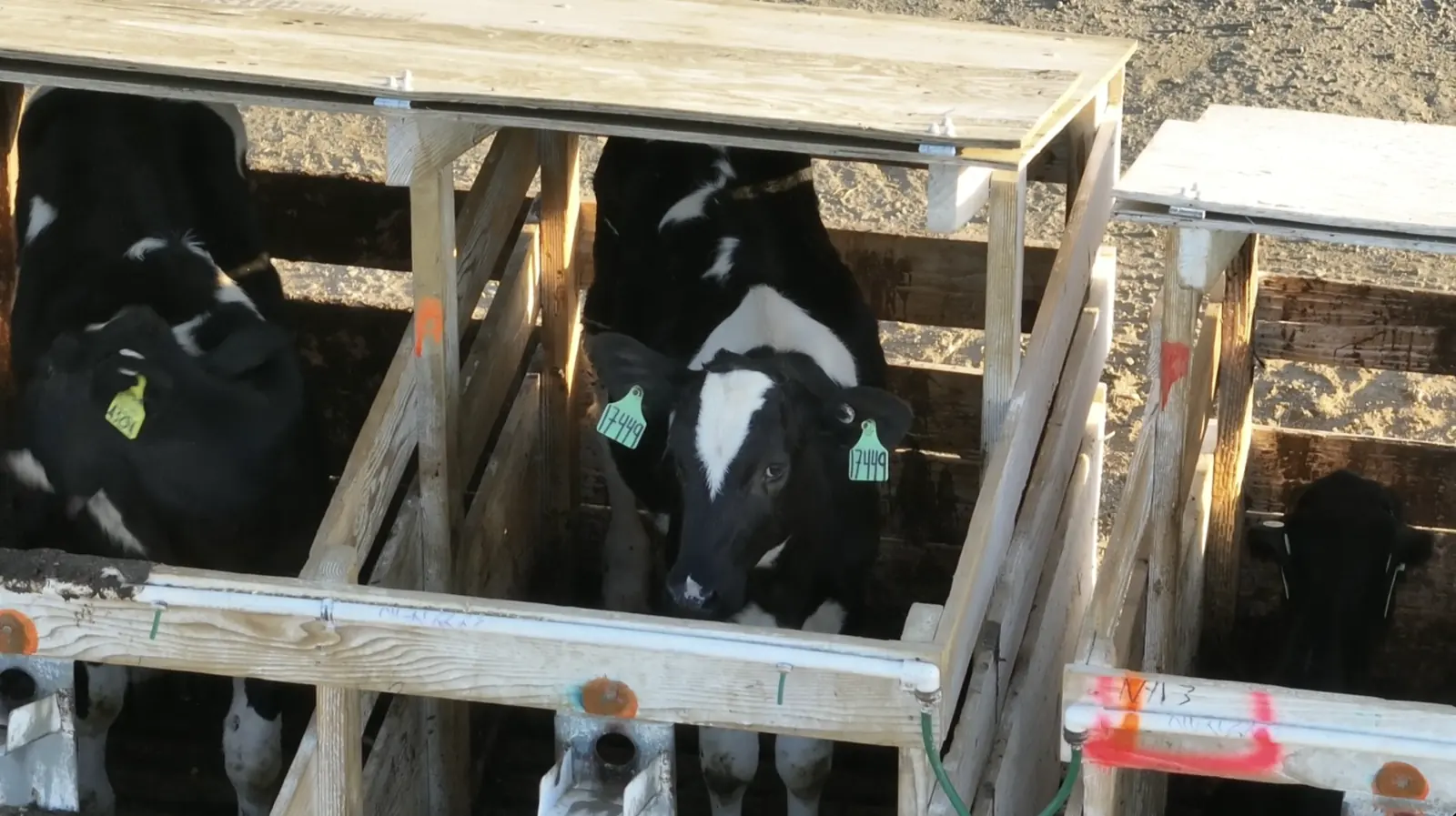
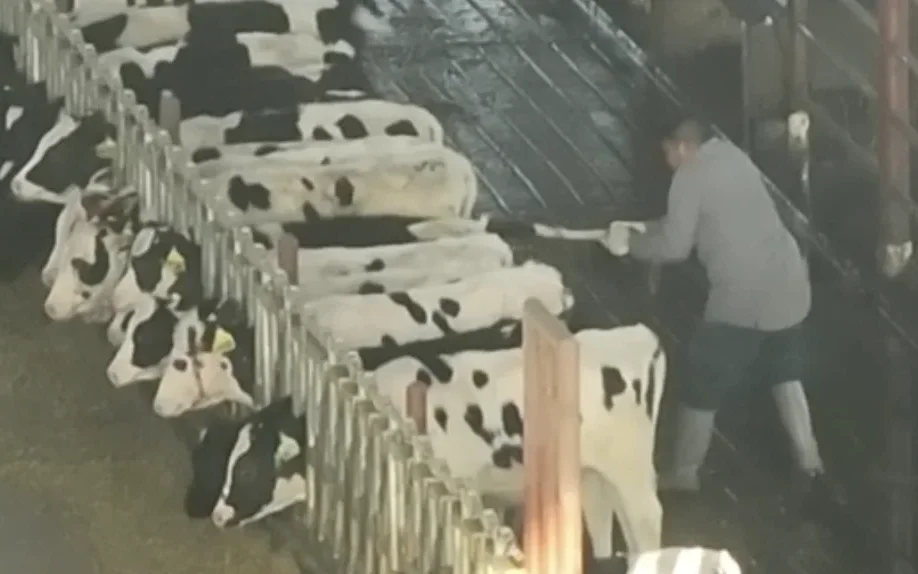
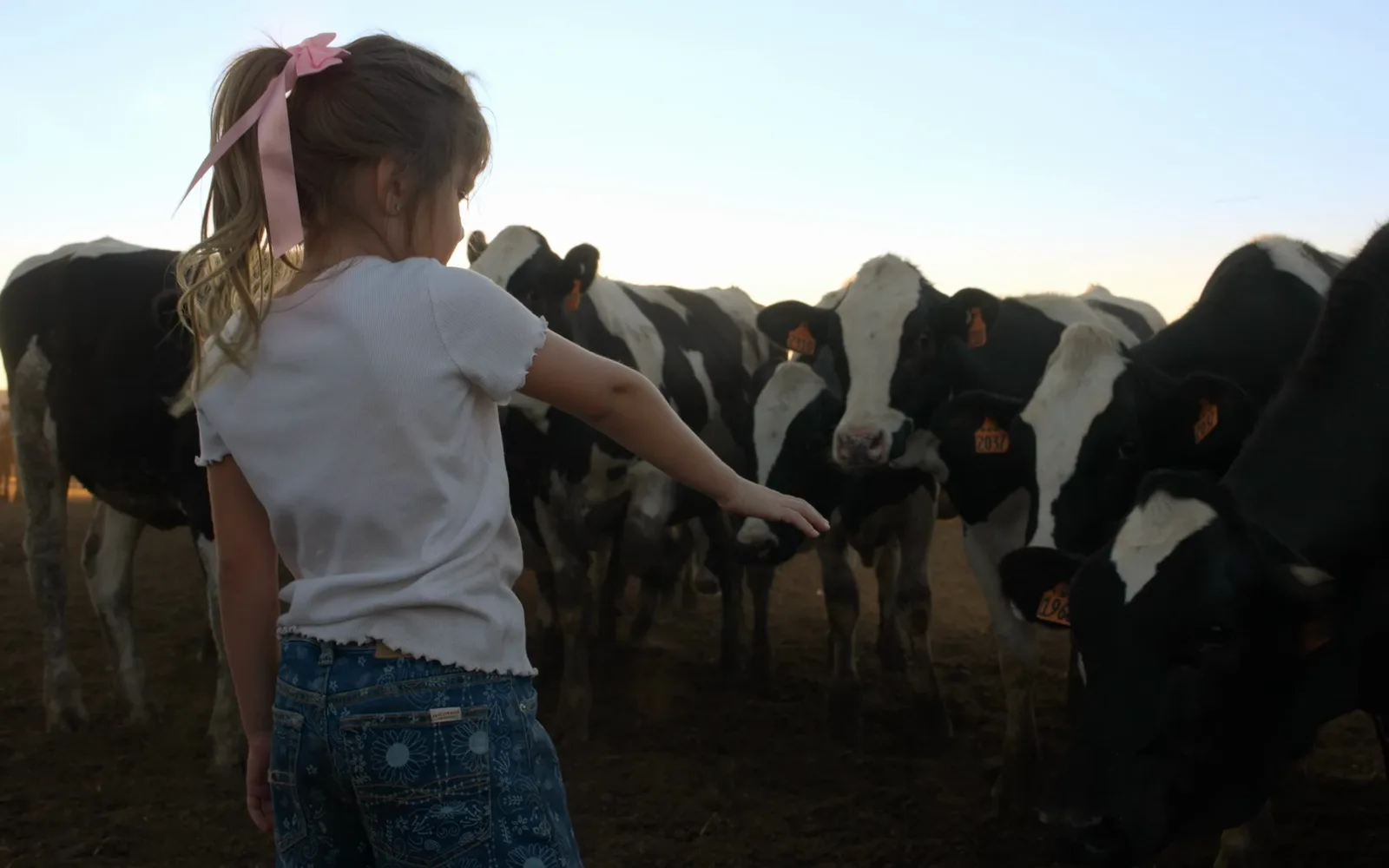
A worker pulls a calf by the tail in a row of calf pens at Agresti Calf Ranch (image mirrored)A girl in a pink hair bow pets dairy cows at sunset, from Real California Milk's Our Farms page video
Drag to compare. Left: the video at the top of RealCaliforniaMilk.com's “Our Farms” page. Right: Direct Action Everywhere footage from Agresti Calf Ranch, Stanislaus County.

There's one ad everyone knows. “Got milk?” But not everyone knows that California, where that highly successful ad originated, is the biggest dairy-producing state in the U.S. No, it's not Wisconsin. California has more dairy cows living on factory farms than any other state, and more than double Wisconsin, which is the next highest. That reality has been masked by advertising. California's dairy industry has worked with the state to run multi-million-dollar marketing programs that have shaped how we see milk.

We've been told “Happy Cows Come from California.” We've seen ads showing cows in grassy fields in the sun. Billboards across California state that 99% of California dairies are family farms.

It's easy for people to believe this marketing, especially when the narrative is largely unchallenged. While the state's agriculture department works with industry on marketing to boost dairy sales, there aren't any state agencies dedicated to showing people the reality of dairy farms. And environmental and animal welfare organizations can't easily compete with multi-million dollar ad programs funded by the industry.
Since the 90s, “Got Milk?” ads have featured A-list celebrities like Britney Spears and the stars of Friends, as well as famous athletes like Shaquille O'Neal. There was even a “Got Milk?” Barbie Doll. The campaign was initially launched by the California Milk Processor Board (CMPB), a marketing board funded by milk processors and administered by the California Department of Food and Agriculture (CDFA) with the goal of increasing milk sales. Then it was picked up by the CMPB's national counterpart, MilkPEP, which represents milk processors nationally, and Dairy Management Inc., which represents dairy farmers nationally. Both are national checkoff programs administered by the USDA; these are programs that collect a mandatory fee from producers of a specific agricultural commodity to fund marketing and research to boost sales. MilkPEP and Dairy Management Inc. pooled their massive budgets and spent $180 million marketing the “Got milk?” campaign nationally.

Who's behind the ads

Government agency
Marketing board
Ad or campaign
Industry partner
  • USDA

    United States Department of Agriculture

    • MilkPEP & DMI

      National dairy checkoff programs

      • Got Milk? nationwide

        Picked up from CMPB

  • CDFA

    California Department of Food and Agriculture

    • CMPB

      California Milk Processor Board

      • Got Milk?

        Celebrity ads, Barbie

California Milk Processor BoardTV commercial · 1993
“Aaron Burr,” the first “got milk?” ad, directed by Michael Bay.

Source: YouTube ↗

In California, where dairy is the largest agricultural sector, the California Milk Processor Board isn't the only board dedicated to promoting milk sales that is run out of the CDFA. The slogan “Happy Cows Come from California” was created by the California Milk Advisory Board, which is also behind the “Real California Milk” seal that you see stamped on products at the store that are made with dairy produced in California.

This state-backed marketing presents consumers with bucolic imagery and claims about family farms, happy cows, and environmental leadership. But let's take a closer look at the size, conditions, and impact of California's dairy industry, and see if “Real California Milk” is showing you the reality.

Who's behind the ads

Government agency
Marketing board
Ad or campaign
Industry partner
  • USDA

    United States Department of Agriculture

    • MilkPEP & DMI

      National dairy checkoff programs

      • Got Milk? nationwide

        Picked up from CMPB

  • CDFA

    California Department of Food and Agriculture

    • CMPB

      California Milk Processor Board

      • Got Milk?

        Celebrity ads, Barbie

    • CMAB

      California Milk Advisory Board

      • Happy cows campaign

        2000s cartoon cow ads

      • Real California Milk

        Seal and RCM website

California Milk Advisory BoardTV commercial · 2000s
“To California,” one of the Happy Cows spots, posted with the tagline “Great milk comes from Happy Cows. Happy Cows come from California!”

Source: YouTube ↗

Claim 1: California Dairies Are “Family Farms”

The California Milk Advisory Board claims “Ninety-nine percent of California dairies are family owned and operated.” This is a frequently cited statistic across its “Real California Milk” marketing and website, which highlights families, particularly young kids, who live on dairies.

This talking point obscures both the reality of who actually does most of the labor on California's massive dairies (predominantly Latino workers) and what conditions the cows live in. “Family-owned” is simply a legal definition describing ownership. According to the USDA, “a family farm is any farm where the majority of the business is owned by the operator and individuals related to the operator, including through blood, marriage, or adoption.” It's entirely compatible with an operation confining thousands of cows. It's also common for a single family to own and operate several such dairies at once. The Verwey family, for example, operates multiple large-scale dairies across the Central Valley including Philip Verwey Farms, the largest dairy in the state with 10,000 milking-age cows and 7,500 pre-milking-age cows. A dairy of that size, run under a family name, is still counted in the 99 percent.

Who's behind the ads

Government agency
Marketing board
Ad or campaign
Industry partner
  • CDFA

    California Department of Food and Agriculture

    • CMAB

      California Milk Advisory Board

      • Happy cows campaign

        2000s cartoon cow ads

      • Real California Milk

        Seal and RCM website

      • 99% family farms

        Billboards, website

California Milk Advisory BoardWebsite

Source: RealCaliforniaMilk.com, “Our Farms” ↗

For another example, the De Jong family operates 29 dairies across California, that together confine a total of over 96,000 animals. Each of these dairies counts in the 99 percent.

California's dairy industry can be 99 percent family farms and a similar percent factory farms at the same time. Those two statistics don't contradict each other. The success of this industry talking point relies on people conflating “family farm” with the kind of small, pastoral farm that pre-dates factory farming. In reality, California's dairies are getting bigger and more industrialized. They increasingly transport newborn calves to specialized calf-raising operations that confine and feed calves from multiple dairies. The largest calf-raising company in the state, Grimmius Cattle Company, confines around 200,000 calves across its two main locations, and it, too, markets itself as a family farm. Grimmius refers to its hundreds of employees as “our family of team members.” Many of those so-called family members are suing Grimmius for wage theft, failing to provide safety devices and safeguards, failing to provide heat recovery periods, and other violations.

Consider this: Walmart is a family company. The Walton family owns a controlling stake. It's legally a family business, despite being the largest company by revenue in the world. Cargill, the largest privately held company in the U.S., is similarly controlled by the Cargill-MacMillan family, and Koch Industries, the second-largest, is owned by the Koch family. These multinational, multibillion-dollar operations show that a family company isn't necessarily small, local, or ethical. These companies just have concentrated family ownership at the top, which is exactly the sleight of hand “99% family-owned” performs for California's dairy industry.

The redirection continues with the images of young kids that routinely accompany this statistic in California dairy ads. On the “Our Farms” page of RealCaliforniaMilk.com, you might expect to learn something about how California dairies actually operate. Instead, the page's centerpiece is a set of five short videos titled “California Dairy Stories” and every one of them is about children. “Curious Little Minds” promises “real curious kids.” “When Dairy Runs In The Family” explains that “dairy kids don't just inherit the dairy farm, they inherit the way of life.” “Farm Family Is Everything” frames the appeal as working alongside people you love. And “Growing Up Free Range,” captures the sleight of hand in its own tagline: “Childhood looks a little different here. It's open, free, and full of California dairy.” The kids on the tractors and bikes in cowboy hats are, genuinely, running free. One boy jumps into one of the individual crates that confines newborn calves. The kids are free to roam around the farm. The cows are not.

Nothing on the page mentions how many hours a day a milking cow spends in the milking barn, whether she ever sets foot on pasture, or what happens to her calf. The industry's own marketing tells you exactly whose freedom it wants you picturing when you read “free range,” and which families it wants you associating with dairies: human ones.

Who's behind the ads

Government agency
Marketing board
Ad or campaign
Industry partner
  • CDFA

    California Department of Food and Agriculture

    • CMAB

      California Milk Advisory Board

      • Happy cows campaign

        2000s cartoon cow ads

      • Real California Milk

        Seal and RCM website

      • 99% family farms

        Billboards, website

      • Dairy stories videos

        Five videos about kids

California Milk Advisory BoardVideo series
“Growing Up Free Range,” one of five “California Dairy Stories” videos: “Childhood looks a little different here. It’s open, free, and full of California dairy.”

Source: RealCaliforniaMilk.com, “Our Farms” ↗

Claim 2: “Happy Cows Come from California”

California's dairy industry likes to claim it's better than the rest. Throughout the 2000s, Real California Milk pushed a major ad campaign with the tagline “Great milk comes from happy cows. Happy cows come from California.” The commercials featured California cows chatting with each other about how good they have it, and cows from other places auditioning to become the next “California Happy Cow.” In one audition, a cow asks for “exclusive grazing rights to her own field of alfalfa.”

Who's behind the ads

Government agency
Marketing board
Ad or campaign
Industry partner
  • CDFA

    California Department of Food and Agriculture

    • CMAB

      California Milk Advisory Board

      • Happy cows campaign

        2000s cartoon cow ads

      • Real California Milk

        Seal and RCM website

      • 99% family farms

        Billboards, website

      • Dairy stories videos

        Five videos about kids

California Milk Advisory BoardTV commercial · 2000s
“Who's She,” one of the “Happy Cows” spots, from Real California Milk's YouTube channel.

Source: YouTube ↗

Today, Real California Milk continues to push this narrative with marketing that shows green pastures under a golden sun, and a narrative around California's leading climate, technology, and animal care. A look at each claim tells a far less happy story than the ads depict.

Starting with what the farms actually look like, California's dairies are, on average, the biggest in the country, and they're getting bigger. Food & Water Watch's analysis of USDA data found California's average mega-dairy herd grew 72 percent between 2002 and 2022, while the state lost roughly three-quarters of its smaller-scale dairies over the same period. California now has over 1.7 million dairy cows living on factory farms. That is more than double the next-highest state, Wisconsin.

Ninety percent of California's cows are raised on factory farms in the Central Valley. More are living in factory farms in other parts of the state, like Sonoma County and Glenn County.

Real California Milk's website tells a pastoral story about Northern California: “Rain means green and green means pastures. The climate in this area allows for a lot of pasture-based grazing that mimics the way big herds of migratory animals live in the wild. Every time a cow leaves the milk barn they have a new, fresh area of grass to graze.” It's true that some dairies in Northern California provide cows with seasonal access to pasture. But others are feedlot-style dairies where cows never leave their barren dirt lots. Real California Milk wants to only present one type of farm, as if it's representative of California dairy farming.

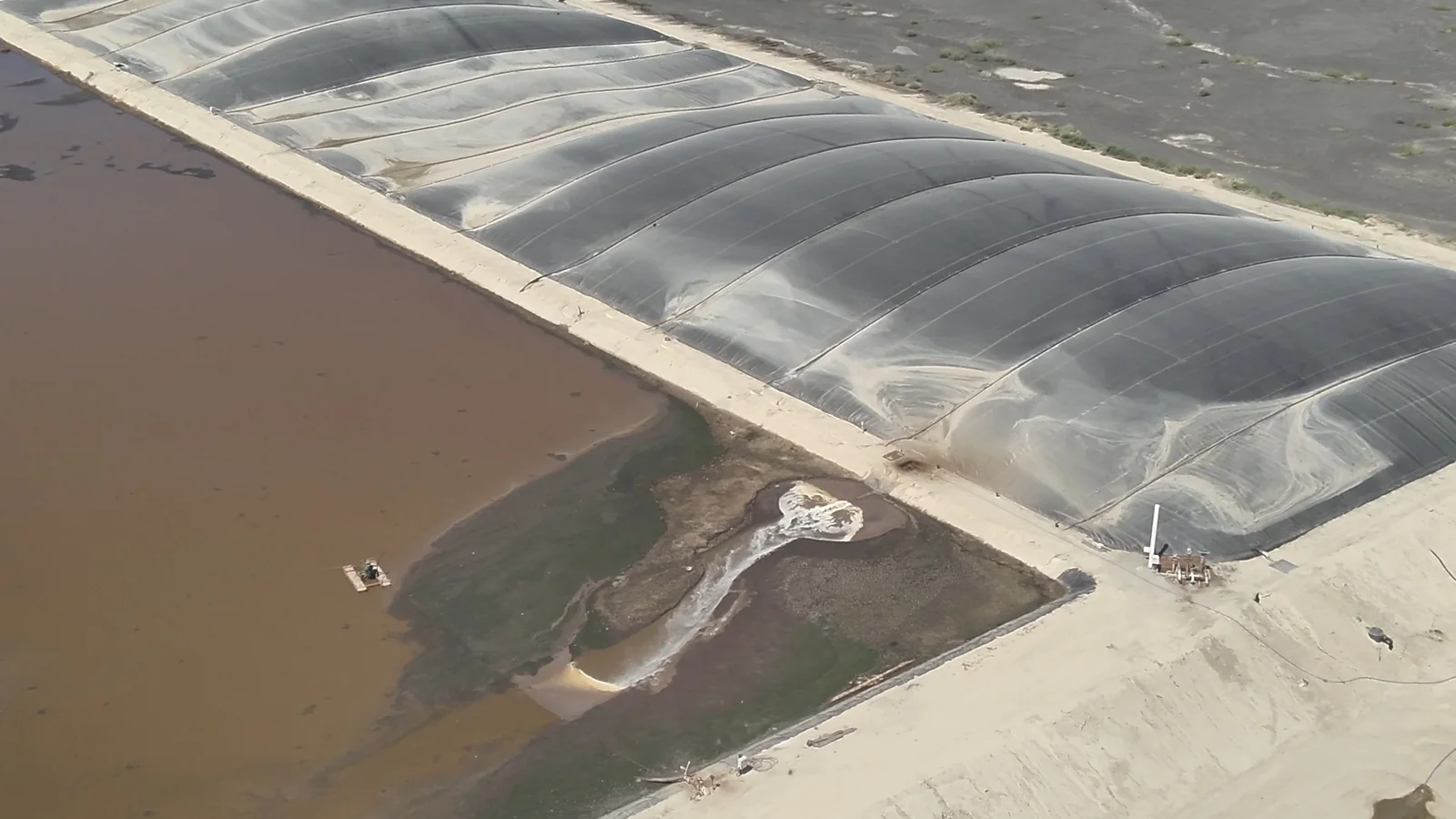
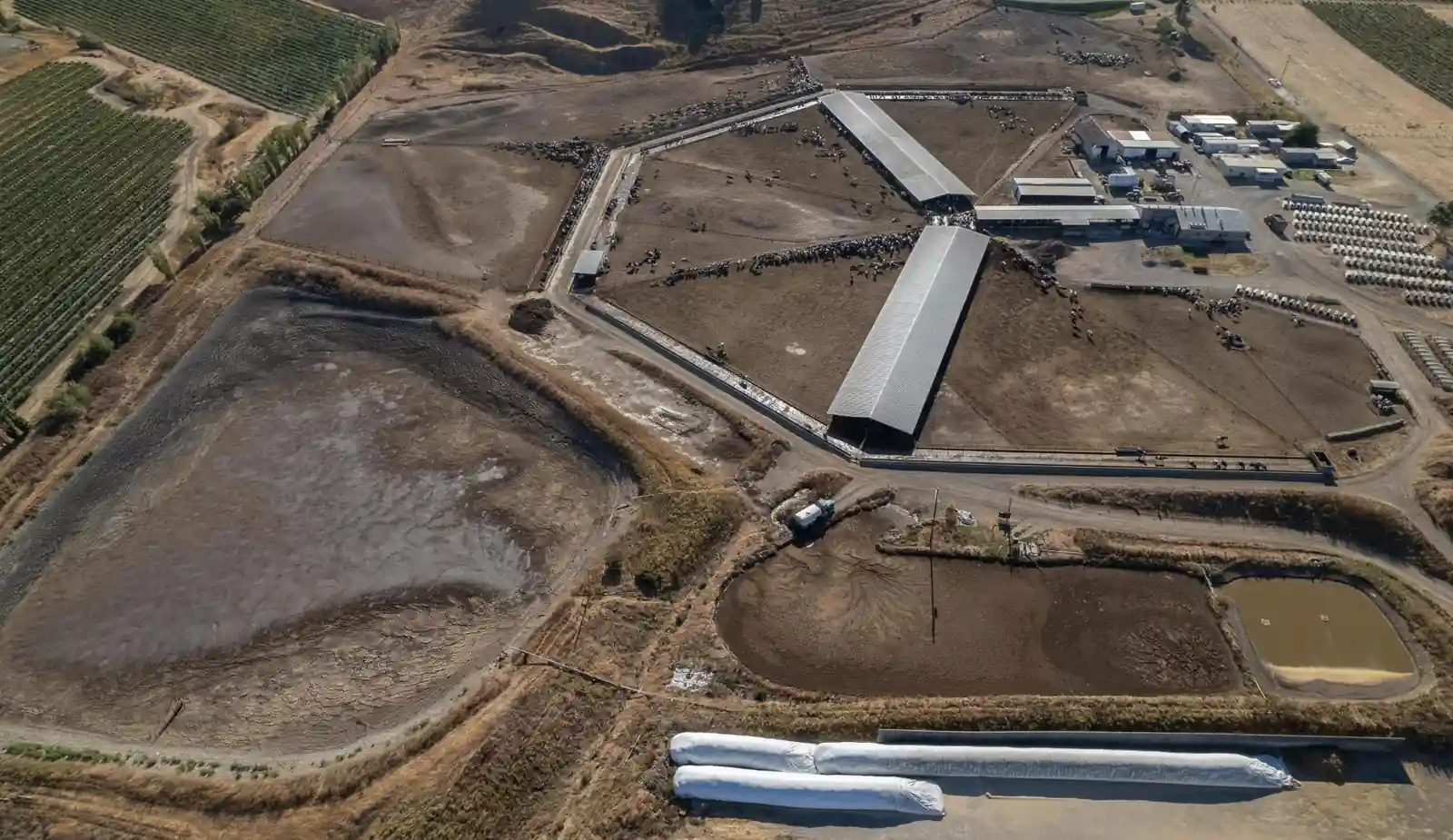
Even behind trusted, “humane” milk brands like Clover Sonoma, there are feedlot-style dairies like Mertens Dairy in Sonoma County, which has no pasture at all. But it does have multiple manure lagoons storing the animals' waste, including one that is the size of two football fields. Unlike RCM's pleasant depiction of the rainy season, rain here brings muddy, feces-filled terrain that the animals have to stand in and a foul odor that locals call the “Sonoma aroma.”

Who's behind the ads

Government agency
Marketing board
Ad or campaign
Industry partner
  • CDFA

    California Department of Food and Agriculture

    • CMAB

      California Milk Advisory Board

      • Happy cows campaign

        2000s cartoon cow ads

        • Green pastures

          Northern California

      • Real California Milk

        Seal and RCM website

      • 99% family farms

        Billboards, website

      • Dairy stories videos

        Five videos about kids

California Milk Advisory BoardWebsite · Northern California

Source: RealCaliforniaMilk.com, “Our Farms” ↗

And what about the hot months of the year? For the parts of the state where the “lots of pasture” story doesn't hold up, RCM has a different pitch: “Farms in this region can get pretty warm. To help make sure the cows are comfortable, farms here use freestall barns to keep the cows cool throughout the summer.” “Pretty warm” is quite an understatement. Summer temperatures in the Central Valley often surpass 100 degrees Fahrenheit. Mild heat stress in dairy cows begins around 77°F; severe heat stress begins in the 90s. Summers in California's Central Valley routinely exceed both thresholds. In early August 2026, the National Weather Service issued a heat advisory for Tulare County, the top dairy-producing county not just in California but in the entire country, forecasting highs of 105–108°F for several consecutive days. That's not “pretty warm.” That's dangerous heat, for days at a stretch, in the county with more dairy cows than anywhere else in America.

Who's behind the ads

Government agency
Marketing board
Ad or campaign
Industry partner
  • CDFA

    California Department of Food and Agriculture

    • CMAB

      California Milk Advisory Board

      • Happy cows campaign

        2000s cartoon cow ads

        • Green pastures

          Northern California

        • Freestall barns

          “Pretty warm” summers

      • Real California Milk

        Seal and RCM website

      • 99% family farms

        Billboards, website

      • Dairy stories videos

        Five videos about kids

California Milk Advisory BoardWebsite · Central Valley

Source: RealCaliforniaMilk.com, “Our Farms” ↗

Lastly, let's talk about that “happy cows” animal care claim. RCM's marketing puts it plainly: “Everything special about California dairy products starts with the cows, and our dairy farms make sure they are well-taken care of. California cows enjoy a healthy diet, consistent medical care, comfortable year-round living conditions, and so much more.” That claim is vague by design.

Who's behind the ads

Government agency
Marketing board
Ad or campaign
Industry partner
  • CDFA

    California Department of Food and Agriculture

    • CMAB

      California Milk Advisory Board

      • Happy cows campaign

        2000s cartoon cow ads

        • Green pastures

          Northern California

        • Freestall barns

          “Pretty warm” summers

        • Comfy cows video

          Animal care claims

      • Real California Milk

        Seal and RCM website

      • 99% family farms

        Billboards, website

      • Dairy stories videos

        Five videos about kids

California Milk Advisory BoardFoodservice website

Source: realcaliforniamilkfoodservice.com ↗

RCM's video “See How Our Comfy Cows Live on Real California Dairy Farms” opens with farmers explaining how important it is to care for calves, who they call “the dairy's future.” The video shows footage of calves with adult cows, but in reality, newborn calves are separated from their mothers within hours of birth at virtually every dairy farm in the world, and California is no exception. This separation is standard practice, done so that the milk the calf would drink can be collected and sold to humans instead. It is also standard practice to confine newborn calves in tiny, individual crates for the first two months of their lives until they are weaned off milk replacer. Many of these newborn calves are shipped to specialized calf-raising operations that confine thousands, sometimes tens of thousands, of newborns from multiple dairies in individual crates. This cuts costs compared to dairies raising their own calves on site. You can read more about calf-raising operations here.

This year alone, Direct Action Everywhere investigators have documented newborn calves confined for months in tiny individual crates, calves kicked in the face and struck with buckets, calves yanked by their tails, calves disbudded with hot irons until they collapse in pain, and calves thrown to the ground from trailers. The farmers in RCM's video repeat variations of the same sentiment without ever citing a specific rule, standard, or regulation that governs how their animals are actually treated. “We would never want to abuse or misuse our cattle because the animals are what pays the bills for us,” one says. Others describe the cows as their “livelihood,” and say they must be managed well so they can “reach their potential.” Yet, another farmer states: “We treat them sometimes better than our own children.” Leaving a child to suffer in triple-digit heat is neglect. Crating a newborn in isolation for months is abuse. So is striking and kicking her. If they did to their children what they do to their cows, they'd be charged with child abuse.

Who's behind the ads

Government agency
Marketing board
Ad or campaign
Industry partner
  • CDFA

    California Department of Food and Agriculture

    • CMAB

      California Milk Advisory Board

      • Happy cows campaign

        2000s cartoon cow ads

        • Green pastures

          Northern California

        • Freestall barns

          “Pretty warm” summers

        • Comfy cows video

          Animal care claims

      • Real California Milk

        Seal and RCM website

      • 99% family farms

        Billboards, website

      • Dairy stories videos

        Five videos about kids

California Milk Advisory BoardPromotional video

Source: YouTube ↗

Claim 3: California's Dairy Industry Is an Environmental Leader

California dairy's marketing leans heavily on sustainability: solar panels, water conservation, and above all, methane digesters that turn manure into fuel. RCM frames this as climate leadership, but supposed advancements and improvements actually underscore how unsustainable the dairy industry is to begin with, and how it's growing and consolidating in dangerous ways.

Take methane digesters, which capture methane released by the manure from dairy cows and, instead of letting it escape into the air, turn it into biogas that can be sold as vehicle fuel. Under California's Low Carbon Fuel Standard, the state pays dairies for that captured methane, meaning the dairies are paid to remove the methane problem that they themselves create. RCM points to this program as proof the industry is leading on the environment. Environmental justice groups argue this subsidizing of waste creates a perverse incentive for dairies to expand and produce even more waste, which comes with a host of other environmental and public health problems.

The payout from the state is based on how much methane a dairy captures, which scales with manure, and thus, herd size. This gives California dairies a financial reason to grow their already larger-than-average herds. But a larger herd doesn't just mean more capturable methane from manure; it also means more of the methane released through cattle's digestive process, called enteric fermentation, which can't be captured at all. The majority of cattle's methane production comes from their burps, not their manure. In 2022, methane from enteric fermentation accounted for 27.4% of total anthropogenic methane emissions in the US, more than three times manure management's 9.2%. Digesters do nothing about that share. They also do nothing about the nitrogen, phosphorus, and ammonia pollution that cattle manure leaches into air and water regardless of whether its methane is captured.

A Center for Food Safety analysis found that California's subsidize-and-incentivize approach to livestock methane is costly for taxpayers and lucrative for factory farm gas producers. The profit incentives built into the program entrench and intensify the very practices causing the pollution in the first place, in already-disadvantaged communities, predominantly San Joaquin Valley communities of color.

Who's behind the ads

Government agency
Marketing board
Ad or campaign
Industry partner
  • CDFA

    California Department of Food and Agriculture

    • CMAB

      California Milk Advisory Board

      • Happy cows campaign

        2000s cartoon cow ads

      • Real California Milk

        Seal and RCM website

      • 99% family farms

        Billboards, website

      • Dairy stories videos

        Five videos about kids

      • Climate leadership

        Digesters, water, solar

California Milk Advisory BoardWebsite

Source: RealCaliforniaMilk.com, “Sustainability” ↗

Regarding water use, RCM's website touts an industry-funded research study that found 88 percent reduction in the water needed to produce a gallon of milk over the past 50-plus years. This is largely because crop yields have increased so much in that time period, and all the water used to grow feed for dairy cows is one of the biggest environmental inputs in dairy production. However, as Civil Eats has reported, in that same time frame, the amount of milk being produced in California has increased. The water per-gallon number doesn't actually mean that total water use by the industry is going down.

As drought has shrunk the surface water available for irrigation in the Central Valley, dairies have depended more on groundwater to make up the difference. Tulare County, the top dairy county, sits atop the Tulare Basin, one of the most severely overdrafted groundwater basins in California, where decades of overpumping by large agricultural operations have caused wells to run dry and land to sink. Dairy waste compounds the damage on the way back down: manure sprayed on nearby fields as fertilizer leaches nitrogen into the ground as nitrates, and in parts of the Central Valley, up to 40 percent of domestic wells now exceed safe drinking water standards for nitrate contamination. Getting more efficient per gallon hasn't stopped the industry's total footprint. Like getting paid by the state for manure, lowering costs on water actually allows dairies to make more money and expand.

Solar energy is similar in that way. RCM highlights solar installations as proof of environmental commitment, and cutting a farm's own energy costs isn't nothing, but on operations already running at industrial scale, cheaper power is also another input cost taken off the table, freeing up capital and making it easier for the biggest dairies to expand further and outcompete smaller operations that can't afford the same infrastructure.

Who's behind the ads

Government agency
Marketing board
Ad or campaign
Industry partner
  • CDFA

    California Department of Food and Agriculture

    • CMAB

      California Milk Advisory Board

      • Happy cows campaign

        2000s cartoon cow ads

      • Real California Milk

        Seal and RCM website

      • 99% family farms

        Billboards, website

      • Dairy stories videos

        Five videos about kids

      • Climate leadership

        Digesters, water, solar

California Milk Advisory BoardWebsite

Source: RealCaliforniaMilk.com, “Sustainability” ↗

And digesters haven't just attracted state subsidy dollars. They've attracted big oil money. In 2019, Chevron U.S.A. and California Bioenergy announced a joint investment with California dairy farmers to produce and market dairy biomethane as vehicle fuel, a partnership RCM's own website touts as a “win-win.” The relationship has continued in the years since. The “green” narrative is a PR win for both the dairy industry and the fossil fuel industry, but it's no win for our environment.

Who's behind the ads

Government agency
Marketing board
Ad or campaign
Industry partner
  • CDFA

    California Department of Food and Agriculture

    • CMAB

      California Milk Advisory Board

      • Happy cows campaign

        2000s cartoon cow ads

      • Real California Milk

        Seal and RCM website

      • 99% family farms

        Billboards, website

      • Dairy stories videos

        Five videos about kids

      • Climate leadership

        Digesters, water, solar

      • Chevron biogas deal

        Touted as win-win

California Milk Advisory BoardWebsite

Source: RealCaliforniaMilk.com, “Sustainability” ↗

The “Keep It Real” Campaign

The global plant-based milk market has been steadily gaining ground for more than a decade and is projected to more than triple, from $26.9 billion in 2026 to $96.3 billion by 2035, growing at about 15% per year.

In recent years, Real California Milk has responded to the rise of plant-based milk with a ‘Keep It Real’ advertising campaign, encouraging consumers to stick to real cows' milk. The California Milk Processor Board launched its own “Get Real Inc.” campaign in 2023.

These campaigns are built entirely on the premise that cow's milk is the natural choice, not plant milk. But there is nothing natural about how modern dairy actually works. Artificial insemination is not natural. Separating a newborn from her mother within hours of birth is not natural. Machines that suck on cows' udders instead of letting their babies nurse from them are not natural. “Real” milk requires manufacturing every step of a process that would never happen on its own.

Who's behind the ads

Government agency
Marketing board
Ad or campaign
Industry partner
  • USDA

    United States Department of Agriculture

    • MilkPEP & DMI

      National dairy checkoff programs

      • Got Milk? nationwide

        Picked up from CMPB

  • CDFA

    California Department of Food and Agriculture

    • CMPB

      California Milk Processor Board

      • Got Milk?

        Celebrity ads, Barbie

      • Get Real Inc.

        2023 campaign

    • CMAB

      California Milk Advisory Board

      • Happy cows campaign

        2000s cartoon cow ads

      • Real California Milk

        Seal and RCM website

      • 99% family farms

        Billboards, website

      • Dairy stories videos

        Five videos about kids

      • Climate leadership

        Digesters, water, solar

      • Chevron biogas deal

        Touted as win-win

      • Keep It Real

        Response to plant milk

California Milk Advisory BoardInstagram post · 2026
A Fourth of July post from Real California Milk: “Keep it real. This 4th, exercise your right to…”

Source: Instagram ↗

Conclusion

That vague image in your head of happy California cows in the grass is the result of an expensive and highly coordinated marketing effort from dairy industry groups with the backing of state and federal agencies like the CDFA and USDA. They want consumers to buy milk, and more of it, so they craft slogans, messaging, and happy cow cartoons all to that end. They want people to believe that California dairy is better, but the evidence does not back that up.

From “family farms” that include 10,000-cow mega-dairies to “environmental leadership” that pays dairies to convert one small slice of their pollution while growing the herds that produce the whole pie of pollution from dairy production, the marketing is incredibly deceptive.


Copyright 2025 © FactoryFarmWatch.org