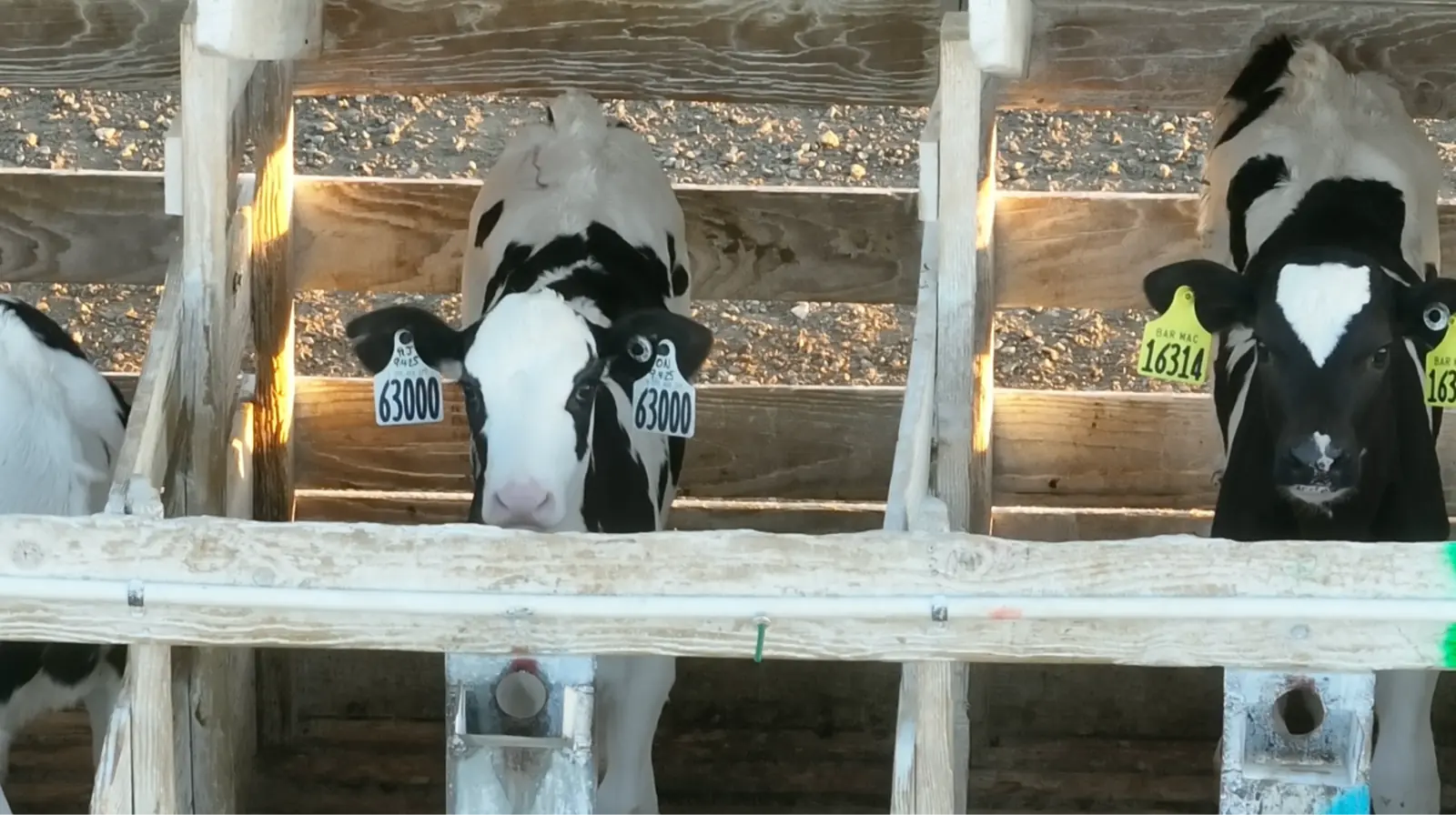
 Grimmius Cattle Company | Kings County
Most people know that milk comes from dairy farms. Far fewer have ever heard the term calf-raising operation. It's not a common talking point of the dairy industry to tell people what happens to the millions of calves born as a byproduct of their industry each year.
Across California, primarily in the Central Valley, dozens of calf-raising operations receive newborn calves from dairies and raise them during the first months of their lives. These facilities play a critical role in modern industrial milk production, yet they remain largely invisible to the public.
Recent investigations by Direct Action Everywhere (DxE) and reporting by Vox and the Los Angeles Times have drawn new attention to calf-raising operations, exposing a system in which newborn calves routinely endure intensive confinement, neglect, and violent handling.
What Is a Calf-Raising Operation?
A calf-raising operation, sometimes called a calf ranch or calf nursery, is a facility that specializes in raising calves from the dairy industry after they are separated from their mothers.
Some dairy farms raise all of their calves on-site, but increasingly, modern dairy farms transport newborn calves to specialized facilities that confine and feed calves, often from multiple dairies. California's largest calf-raising company, Grimmius Cattle Company, confines around 200,000 calves across its two main locations, and these newborn calves arrive from dozens of dairies throughout the state. Calves arrive shortly after birth, often at just one day old. They typically remain at the calf ranch for two to five months before being transferred into either the dairy or beef industries.
Why Does the Dairy Industry Use Calf-Raising Operations?
The dairy industry uses calf-raising operations because they allow dairies to outsource one of the more labor-intensive parts of production.
Just like other mammals, dairy cows must give birth in order to produce milk. As a result, millions of calves are born each year as a byproduct of milk production. Long before they will generate any revenue, those calves require labor including housing, feeding, and vaccinations. It is also common to perform a procedure on calves called disbudding, which entails removing or destroying their horn-producing cells so they will not develop horns.
Rather than dedicating space and employees to raising calves, many dairies send them to specialized calf ranches. Concentrating calves from multiple farms in one location can reduce costs and allow the industry to raise large numbers of animals as efficiently as possible.
The growth of large-scale dairies in California has been accompanied by the growth of large-scale calf-raising operations that serve as centralized hubs within the dairy supply chain.
Source: California Air Resources Board
As shown by the CA Air Resources Board's data, the number of calves on solely calf raising operations has grown steadily, overtaking the number of calves raised on facilities alongside mature cattle. This change has unfortunately led to a widespread growth of intensive confinement at these specialized facilities.
What Does Life Inside a Calf-Raising Operation Look Like?
One of the defining features of calf-raising operations is the intensive confinement of newborn calves in individual crates, though the style and dimensions of these crates varies by facility. At Grimmius Cattle Company, calves are confined in crates measuring roughly 13 square feet.
Calves typically spend two to three months in these crates, with just enough room to stand up, lie down, and turn around (sometimes hitting the sides of the enclosure when they turn around). Then, after they are weaned off milk, they are often transferred to dry lots for another two to three months.
During the months they are confined in crates, the calves are isolated from one another at a critical period of social development. Research on dairy calf welfare consistently finds that housing, space allowance, and social contact can significantly affect calf health and wellbeing. A study in the Journal of Dairy Science found that calves raised in isolation had deficient social skills, difficulties in coping with novel situations, and cognitive deficits. And an April 2026 study in Nature showed calves are highly motivated to play, especially after play behaviors have been restricted due to limited space.
Additionally, there is a strong argument that these housing systems are in fact illegal, given that they do not provide the animals any room to exercise, which is a violation of CPC 597t.
Beyond confinement itself, recent investigations have documented alarming examples of animal cruelty and abusive handling at multiple calf-raising operations across California.
In February 2026, a Direct Action Everywhere investigation at Agresti Calf Ranch in Stanislaus County revealed workers kicking calves in the face, yanking them by their tails, and restraining calves by pulling with their full body weight on pliers attached to the animals' sensitive noses. They also gathered footage of disbudding, a process which uses a hot iron to burn the horn-producing cells, in order to prevent their horns from growing.Industry guidelines call for pain medication during disbudding because the procedure is known to be painful, but investigators documented approximately an hour of near-continuous disbudding without observing workers administer anesthetics. Animal welfare expert Temple Grandin reviewed the footage and told the LA Times that the calves' reactions suggested pain relief had not been used.
At Kiss Cattle Company, a Fresno County calf ranch that houses roughly 7,000 calves at a time, DxE investigators documentedworkers beating calves and dragging them by their ears and tails.
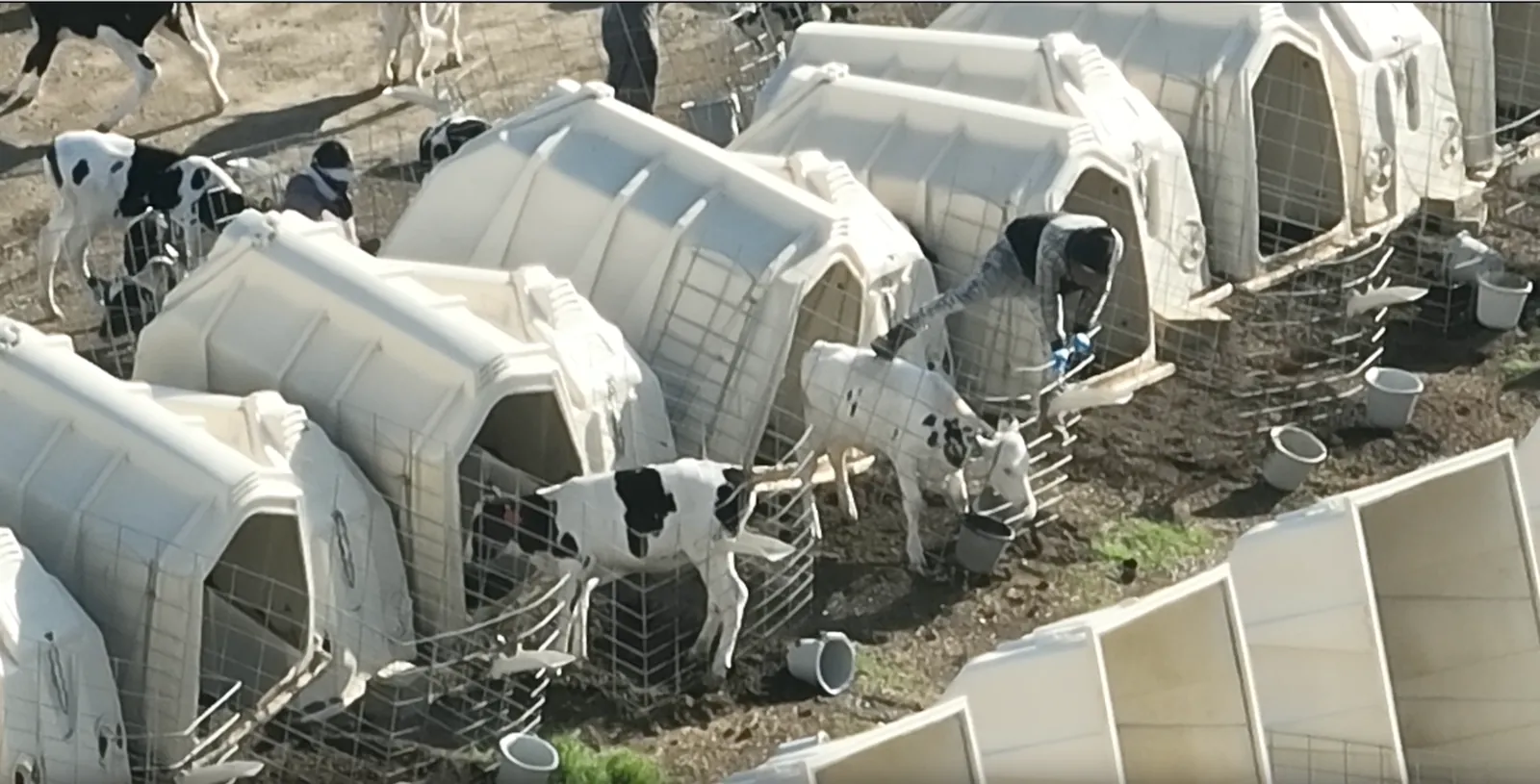
And at Grimmius, a months-long investigation documented repeated abusive handling, including sick calves dragged and shot in the head, as well as calves left to die from neglect inside their crates.
Advocates argue that these practices constitute the negligent and intentional infliction of pain and suffering prohibited under California Penal Code Sections 597(a) and 597(b), which prohibit animal cruelty and torture. They also violate the dairy and beef industries' own animal care standards.
For example, the Calf Care & Quality Assurance (CCQA) program—the dairy and beef industries' primary calf welfare certification program—states: “Do not drag, pull, throw, or toss calves. Do not catch calves by the neck, ears, limbs, tail, or other extremities.” The program specifically identifies dragging calves by their tails or ears as an example of animal abuse.
When cruelty is caught on camera, calf ranches and dairy companies have tried to write it off as an “isolated incident.” But each new investigation makes it more and more clear that the conditions are not isolated incidents; they are an expected part of a system that relies on separating calves from their mothers shortly after birth and transporting them to facilities designed to raise large numbers of animals as efficiently as possible.
What Happens to Male Calves?
Male calves cannot produce milk and therefore occupy a different role within the dairy industry.
Historically, many male dairy calves entered the veal industry. Today, increasing numbers are raised for beef production instead. According to the American Farm Bureau Federation, “the sharp decline in veal production — calf slaughter dropped from 1.79 million head in 1990 to just 293,600 head in 2023, a 84% decline — has likely redirected more dairy-origin calves toward beef production rather than traditional veal markets.”
After spending their first months at calf ranches, male calves are typically transferred to feedlots and eventually slaughtered for meat.
Grimmius, for example, sends male calves to major feedlots including Brandt Cattle Company in Imperial County, which is the largest cattle feedlot on the West Coast.
What Happens to Female Calves?
Like males, many female calves go on to enter the beef industry, but some female calves are retained as replacement animals for the dairy industry. The number depends on how many new dairy cows a farm needs to replace older cows whose milk production has declined and who are thus less profitable to the company and will be sent to slaughter.
After leaving calf-raising operations, these female calves who are destined for dairy production go to either a heifer ranch or a dairy farm where they are raised until they are old enough to become pregnant and produce milk. Heifer ranches, like calf ranches, are highly specialized facilities that raise a specific age of calf. A heifer is a young female cow who has not yet given birth to a calf. Once she has her first calf, she is officially considered a “cow.”
Conclusion
For most people, calf-raising operations remain largely invisible. Yet these facilities have become an increasingly prevalent part of modern dairy production, receiving newborn calves and raising them by the thousands in factory-like conditions.
As investigations continue to document what life is like for animals in California's calf ranches, they are highlighting the need for transparency, accountability, and systemic improvements in the treatment of some of the youngest and most vulnerable animals in the food system.
This is especially important because California is the nation's largest milk-producing state, producing nearly one-fifth of the country's milk supply. What happens here offers a window into the harsh realities of the dairy industry, an industry that fundamentally relies on separating newborn babies from their mothers — and increasingly, shipping those vulnerable newborns to factories where intensive confinement and rough handling are the standard.